
A group photo of the workshop participants comprising clinicians, researchers, and staff members of Synapse - Pakistan Neuroscience Institute with CBEC Faculty Sualeha Shekhani and Aamir Jafarey.

STRENGTHENING ETHICS CAPACITY AT SYNAPSE
CBEC-SIUT has initiated a series of capacity-enhancement activities with Synapse, Pakistan’s Neuroscience Institute. The institute, established in 2021, provides multidisciplinary services in the areas of mental health and neuroscience, bringing together expertise from a range of clinical and allied disciplines. CBEC is engaging with Synapse through two initiatives:
Establishing a Research Ethics Committee (REC)

To support the establishment of a Research Ethics Commit-tee (REC) at Synapse, CBEC faculty members Dr. Aamir Jafarey and Ms. Sualeha Shekhani conducted two work-shops on June 6 and 13 (picture below from June 6). The workshops provided participants with an overview of the importance of ethics governance and the role of institutional ethics review in promoting ethical research practices. Twelve participants from a wide range of disciplines attend-ed each workshop. The sessions, using cases specific to mental health research, focused on the development of robust governance structures, ethical review processes, and institutional mechanisms that are responsive to the organi-sation’s context and research needs.
Sessions: Ethics in Mental Healthcare
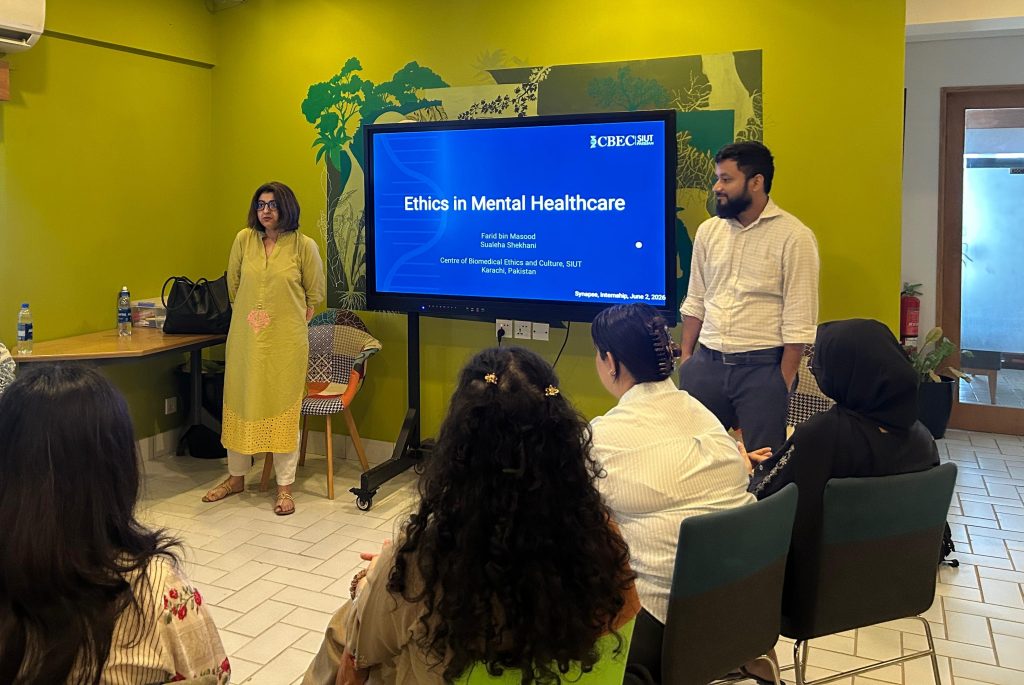
During Synapse’s summer internship with high school and undergraduate students, CBEC was invited to lead sessions across three internship batches (picture above from the first batch). The sessions, led by Mr. Farid bin Masood and Ms. Sualeha Shekhani focused on informed consent, confidenti-ality, and decision-making in cases involving impaired capacity. Using mini-cases, participants reflected on the ethical tensions between patient autonomy and the use of coercive interventions in psychiatric care. The workshops also introduced ethical considerations in mental health research, including protections for vulnerable populations, and the risk of therapeutic misconception.