
Category Archives: No Title

Moral Midwifery

Dr. Aamir Jafarey (second from left) presents Dr. Daryl Pullman, Visiting Professor during the Clinical Ethics Module in May 2023, an Ajrak and Sindhi cap as tokens of appreciation from CBEC faculty. (More information available on page 10.)

Moral Midwifery: One way to think about the nature and purpose of Clinical Ethics Consultation

Daryl Pullman*

In this brief reflection on the nature and purpose of Clinical Ethics Consultation (CEC), I propose that we think of the ethics consultation process as analogous to ‘moral midwifery.’ However, before explaining why I chose this particular analogy for explaining my understanding and approach to ethics consultation, I want to emphasize that this is only ‘one way’ of thinking about CEC. I emphasize this because if there is consensus on anything when it comes to understanding the nature and purpose of CEC, it is that there is no consensus on this subject.

The origins of what was to become the current practice of CEC in North America can be traced to the early 1960s in Seattle, Washington. In the early days of kidney dialysis demand far exceeded the extremely limited supply of dialysis units available. In order to deal with the ethically fraught questions regarding who would or would not receive dialysis, Seattle’s Swedish Hospital organized a committee consisting of both lay and professional members to review individual cases. Labelled the ‘God committee,’ this body literally determined who would live and who would die.1

Dialysis was only one of many high tech interventions making their way into mainstream medicine in the 1960s and 70s. Such technological marvels increased the power of medicine to extend the lifespan, but also presented the ethical challenge of ‘unnatural selection;’ where once we could only provide care and comfort while nature took its course, we now had the power to curtail and in some cases even reverse the natural course of disease. Governments and healthcare authorities began looking to the field of ethics for guidance. Hence the emergence of modern bioethics and with it CEC.2

However, as more hospitals and health authorities established ethics committees and ethics consultation services, questions arose about how to evaluate the effectiveness of the consultation process. The theme of a conference held in Chicago in 1995 was ostensibly the ‘Evaluation of Ethics Case Consultation,’ but the organizers acknowledged the difficulty of evaluating efficacy when there was no consensus on what the goals of CEC were in the first place.3

There are complex reasons for requesting a CEC including issues of resource allocation, differences of opinion amongst the clinical team, or tensions between clinicians and patients and/or their families about an appropriate course of treatment. The challenge of specifying clear goals for CEC is exacerbated by the diverse backgrounds of those involved in performing this service. While some clinical ethics consultants are medically trained, others are not. There is also wide variation among models for providing CEC and the practice of ethics consultants within these models. Institutions may conduct CECs through a hospital ethics committee or a formal ethics consultation service, while others rely on a single ‘ethics consultant’ to provide guidance.

Ambiguities about what it means to be a clinical ethics consultant and how to assess effectiveness have persisted. In 2022, BMC Medical Ethics published an extensive scoping review of reported outcomes for CEC.4 The review concluded that CEC suffered from a lack of standardization that was hindering “the provision of high quality intervention and CEC scientific progress.” It seems not much has changed since the Chicago conference a quarter of a century earlier.

The scoping review closes with a quotation from Aristotle’s Nicomachean Ethics. Aristotle states: “Our discussion will be adequate if it has as much clearness as the subject matter admits of, for precision is not to be sought for alike in all discussions . . .” Aristotle understood that we should not expect to quantify and measure outcomes in ethics in the same way that we measure scientific progress. Medicine is both art and science. Much in the realm of ethics is about the art of medicine; it deals with matters of the heart as well as the intellect. The modern penchant, while understandable, for ‘evidence based medicine’ comes up short when attempting to categorize, quantify and measure CEC. The authors of the scoping review acknowledge Aristotle’s wisdom but seem reluctant to apply it to their own study.

This brings me to my characterization of CEC as analogous to ‘moral midwifery.’ While I have worked as a clinical ethics consultant for over three decades, early on I struggled with these very issues. How would I measure whether or not I was making a difference? Modern medicine has become a system of highly specialized fields, and it is common practice to rely on specialist consultants. Although I lacked formal medical training, I had extensive post-graduate training in philosophical and applied ethics. Did I want to be seen as the ‘ethics expert’ who advised on all things ethical? While my ethics training provided certain tools for assisting in sorting through the complexities of various ethical conundrums, I resisted being characterized as the ‘moral expert.’

Socrates struggled with similar issues when approached to advice on various matters. He resisted being viewed as the expert, claiming (somewhat improbably) that he really did not know anything. He insisted that those who sought him out already knew the answers to the questions that perplexed them; his role was to act as a ‘midwife’ to assist in delivering the wisdom already residing within them.

References:

  1. http://www.nephjc.com/news/godpanel
  2. Bell, J.A.H., Salis, M., Tong, E. et al. (2022) Clinical ethics consultation: a scoping review of reported outcomes. BMC Medical Ethics. 23,99: 1-65.
  3. Fletcher, J.C., Siegler, M. (1996) What are the goals of ethics consultation? A consensus statement. Journal of Clinical Ethics 7,2: 122-6.
  4. Jonsen, A.R. (1998) The Birth of Bioethics. New York: Oxford U Press.
*Professor, Centre for Bioethics, Faculty of Medicine, Memorial University of Newfoundland, NL, Canada

Influence of Culture and Language: Decision-making in Breast Cancer Patients

Influence of Culture and Language: Decision-making in Breast Cancer Patients

Bushra Shirazi
Consultant Breast Surgeon, SIUT and faculty CBEC
Volume 7 Issue 2 December 2011

Contemporary bioethics places a great deal of emphasis on the patient’s autonomy, important aspects of which include complete disclosure about the disease, and the patient’s right to make informed decisions about therapy. However, the extent of information imparted to patients may differ in various cultures. With the objective of exploring the influence of local culture on the disclosure of illness and subsequent decision-making, I conducted an empirical study in a Karachi hospital on women diagnosed with breast cancer. My study included detailed interviews with twenty four patients as well as with the female surgeon involved in their care.

One of the most interesting findings that emerged from my study was the use of language by patients and doctors. Patients I interviewed generally avoided the word “cancer” and, if the word came up during discussion, from using it as ‘first person’ statements. Therefore they would say that “the disease was cancer” instead of “I have cancer.” The terms commonly used instead of “cancer” included bimaari (illness), rasoli (a generic word for a mass) or yeh cheez (this thing), while some patients called it a khatarnak bimaari (dangerous illness). Two patients disclosed that family members also avoided using the word cancer. One respondent expressed her annoyance at being called a “cancer patient” by junior doctors, something she said “senior” doctors did not do. In her opinion, though this word may be routine for doctors, it magnified the stress and fear of the patient. She narrated that when the oncologist asked her outright if she knew what her disease was and told her that she had cancer, she burst into tears.

Others believed that the disclosure of cancer could kill the patient. In one case where the patient could not speak Urdu, her daughter (who was acting as interpreter) told me that she used the word rasoli (tumor) to refer to the cancer, and had informed her mother that “a small operation” was required. Following surgery, when the mother realized that her breast had been removed, the daughter told her that it was done to prevent the rasoli from spreading. When I enquired if this was not deception the daughter replied, “This disease is life-threatening. But the disease does not kill a person as quickly as telling someone that your death is on its way.”

Hufeland (1762-1836) said that “to prophesy death is to cause it.” My study suggests that as the word cancer was interpreted as imminent death by some using euphemisms like illness or tumor may serve as a mechanism to distance the disease from death. The consulting surgeon I interviewed confirmed the taboos surrounding the word cancer, and said that the word she too routinely uses to patients is rasoli (tumor). In her experience with patients she said, “once the word cancer is used the [patient’s] mind goes numb.” She said that somewhere during multiple visits the word cancer may be mentioned, but not always.

My interviews revealed that avoiding the word cancer does not imply that patients were ignorant of the diagnosis. A patient told me, “Nobody said the word but I just knew.” It seemed to me that although patients understood the malignant nature of their disease, it was considered emotionally and psychologically important to use words that “softened”   the impact of the diagnosis and perhaps maintained a sense of hope. Interestingly, my study has led me to reflect on my own use of language as a surgeon, and a realization that I too often avoid the word cancer when speaking with my patients.

CBEC Forum with Asma Nasim

Great Expectations: Ethics of Infectious Diseases in LMICs

Saturday, March 18, 2023

The development of best practices and guidelines by international organizations, societies, and consortiums often takes place in what appear to be Utopian contexts, ignoring resource constraints and stewardship challenges inherent to LMICs. The management of infectious diseases in a low-resource setting requires an acknowledgment of multiple social, economic and cultural realities and the unique ethical challenges they pose.

In our upcoming CBEC Forum, three speakers will discuss ethical challenges related to antibiotic stewardship and equitable global distribution of COVID-19 vaccines within the context of Pakistan and LMICs. They will hope to bring into the local context what may otherwise appear as a pipe dream.

Dr. Asma Nasim is an Infectious Diseases specialist at SIUT and is a member of the European Ethics Advisory Committee (EEAC) of the European Society of Clinical Microbiology and Infectious Diseases (ESCMID) since 2021. She is a PGD alumnus of CBEC.

Dr. Sunil Dodani is an Infectious Diseases specialist at SIUT.

Dr. Natasha Anwar is a Molecular Biologist at Aga Khan Hospital Lab in Lahore. She is also a CBEC Associate Faculty and an alumnus of the PGD and Masters programs.

This session will be conducted in a hybrid format with a limited number of physical seats at CBEC. Those interested in attending the session in person are requested to register by emailing cbec.siut@gmail.com before March 15, 2023.

To register for online participation, please click the Zoom registration link below:

Zoom link: https://us02web.zoom.us/meeting/register/tZYod-6gqTgtE9NNi-tQnczFV1WEWdmXOyW4

This session will also be live-streamed on our Facebook page.

New academic year begins in CBEC

PGD Class of 2020 and MBE Class of 2021 attending the January 2020 Foundation Module in CBEC campus. This was the only module this cohort attended physically before teaching modules moved online due to Covid-19 pandemic.

New Academic Year Begins in CBEC

CBEC welcomes incoming students to its Master in Bioethics (Class of 2024) and Postgraduate Diploma in Biomedical Ethics (Class of 2023) programs. The “Foundation Module” is scheduled on campus from January 9 to 21, 2023.

MBE, Class of 2024

Jamal Azfar Khan
Internal Medicine
PNS Shifa
Karachi
Farid Bin Masood
Social Sciences
CBEC, SIUT
Karachi


PGD, Class of 2023

Huma Ali
Pharmaceutical Sciences
Jinnah Sindh Medical University
Karachi
Muhammad Arsalan Khan
General Surgery
Sindh Institute of Urology
& Transplantation, Karachi
Shireen RamzanAli
Surgery & Medical Education
Sir Syed College of Medical Sciences
for Girls, Karachi
Seema Hashmi
Pediatric Nephrology
Sindh Institute of Urology
& Transplantation, Karachi
Atif Mahmood
Physiology
Bhitai Dental & Medical College
Mirpurkhas
Abubaker Ali Saad
Cardiology
D. G. Khan Medical College
& Teaching Hospital, D.G. Khan
Sannia Perwaiz Iqbal
Family Medicine
Bahria University Health Sciences
Karachi
Asif Jan Muhammad
Medical Services
Pakistan Petroleum Limited
Karachi
Saima Saleem
Media
Sindh Institute of Urology
& Transplantation, Karachi
Sadia Ishaque
Infectious Diseases
Shaheed Mohtarma Benazir Bhutto Trauma Center, Karachi
Muhammad Saqib Rabbani
Behavioural Sciences
University of Health Sciences
Lahore
Beenish Syed
Infectious Diseases
Sindh Infectious Diseases Hospital
& Research Center, Karachi
Ali Kamran
General Surgery
Ziauddin University Hospital
Karachi
Muhammad Waqas Rabbani
Behavioural Sciences
Shifa College of Medicine
Islamabad
Aisha Yaqoob
Obstetrics / Gynaecology
Kharadar General Hospital
Karachi

Farhat Moazam Receives Hastings Center Founders’ Award

A group photo of Dr. Farhat Moazam’s colleagues and friends at the event celebrating her Bioethics Founders’ Award from the Hastings Center.

Farhat Moazam Receives Hastings Center Founders’ Award

Dr. Farhat Moazam, CBEC’s Chairperson, received the Hastings Center Bioethics Founders’ Award for 2022. The award is conferred annually on individuals from across the world in recognition of substantial and sustained contributions to bioethics. Dr. Moazam was cited for her “remarkable range of accomplishments as a pediatric surgeon and an educator, ethicist, ethnographic researcher and institution builder.” The other recipient for the year was Anita L. Allen, Professor of Law and Philosophy at the University of Pennsylvania. Previous recipients of the award have included Henry Beecher, James F. Childress, Tom Beauchamp and Renee’ Fox among others. Dr. Moazam is the first woman from Asia to receive the award.

To mark the occasion, a dinner was organized by Dr. Adib Rizvi, Director of SIUT, CBEC faculty, and Dr. Moazam’s erstwhile residents and students in surgery and bioethics, several of whom are now working in leadership positions in different institutions in Pakistan. Colleagues from across the world sent Dr. Moazam congratulatory video messages, and those present reminisced about their long association with her as their teacher. The event ended with a dinner on the terrace outside CBEC on a balmy Karachi evening.

A Woman’s World Through Zehra Nigah’s Poetry

Zehra Nigah sahibah reciting her poetry in CBEC to a rapt audience of faculty, physicians and invited guests on November 5, 2022.

A Woman’s World Through Zehra Nigah’s Poetry

Farid Bin Masood*

We are very fortunate that Zehra Nigah, a renowned, soft-spoken, octogenarian poet always dressed in a simple Saree, visits CBEC for conversations and to recite her captivating poetry to us.  Hailing from an intellectual, literary migrant family of Hyderabad Deccan (India), Zehra Nigah is one of the only two early female poets of the Subcontinent, the other being Ada Jafarey, to have achieved fame in the mostly male-dominated world of Urdu poetry. She began writing poetry as a child and since then has published three collections of poetry and an anthology.

What I admire most about Zehra Nigah’s poetry is her ability to present difficult social and political issues in the traditional poetic language. The word Nigah in her name means a gaze or a particular perspective. Through her subtle, multi layered poetry, she can describe the agony of a rape victim without resorting to graphic descriptions, and convey the horrendous aftermath of a drone strike on a community without mentioning the drone by name. In doing so, she relies on candid vocabulary but without losing civility and charm. Zehra Nigah is also known for her beautiful, evocative writing which explores the experiences of women in Asian cultures. She not only writes of the love and warmth of a mother for her children and her home, but also of wives who must make compromises, and of daughters compelled to conform to traditional norms against their wishes.

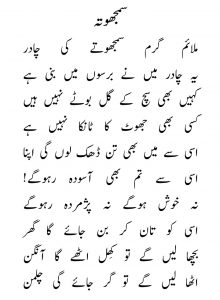
Zehra Nigah’s poem Samjhota (Compromise), reproduced here from her impressive collections, is among my favourites. Using vivid imagery, she captures the living experiences of a woman through the symbolic use of the Urdu word chadar. Chadar is a large, all enveloping garment Asian women wear to conceal their body from the world beyond their homes.  She uses chadar metaphorically to capture aspects of a woman’s life – tenderness, love, warmth, but also personal compromises she makes for the sake of her family.

In January 2023, Zehra Nigah will conduct a session on Humanities and Bioethics during CBEC’s Foundation Module for incoming PGD and MBE students. She will engage in a conversation with Dr. Arfa Sayeda Zehra, Professor of History and Literature, Forman Christian College, Lahore on the historical connections of Urdu literary traditions with Akhlaq (Ethics), Tehzeeb (Culture).

Compromise
(Translation by Farhat Moazam)

My chadar of compromises, soft and warm,
Woven over many years,
Embellished truths like blooms adorn it not
Threads of untruths weave through it not,
I shall conceal myself within it
And you will remain content, at ease!
Neither happy nor sad,
Stretched taut it shall make our home,
When spread our courtyard will blossom,
If raised the curtains will plummet

*Lecturer, Centre of Biomedical Ethics and Culture, SIUT, Karachi

Physicians pack a punch in 55 words

A snapshot from the Zoom recording: Prof. Marcia Childress explains the concept of 55-word stories and her experience with her other students during the pandemic

Physicians Pack a Punch in 55 Words

Aamir Mustafa Jafarey*


“Brevity is the soul of wit,” says Polonius in Shakespeare’s Hamlet. But, as 17th-century French philosopher and mathematician Blaise Pascal said, “I have made this letter longer than usual, only because I have not had time to make it shorter,” brevity is far more challenging than rambling essays. However, ever since author Steve Moss introduced the genre of 55-word stories in 1986, also called “shorties,” these have become a popular mode of creative, reflective expression for many, including physicians.

In medical disciplines, this mode of imaginative expression has been used as a means of connecting practitioners with their humanness, bringing to the fore their own feelings and expressions of which they themselves may be unaware. The amazing thing about these brief stories is that their authors need not be writers, or even connoisseurs of creative works. However, with each attempt at editing, they introduce more poignancy, improve the shorties and provide a surprising window into the writer’s own self.

In 2021, Professor Marcia Childress took a session with CBEC students on humanities and bioethics. This was the height of the Covid-19 pandemic, which was taking its physical and psychological toll on students and faculty alike. She asked our students to pen 55-word stories, reflecting their pandemic experiences. These students had no prior experience in writing stories, long or short, their literary contributions limited to dry scientific articles based on quantifiable data. After overcoming initial trepidation, the students enjoyed the exercise and produced a series of extremely reflective shorties, finding the process cathartic. CBEC faculty, also having experienced the ravages of the pandemic firsthand, took a cue from them and captured their own experiences in shorties.

‘Tis folly to be wise
Farid Bin Masood

Dada got severe Covid-19 symptoms.
He was isolated in a small room of a large home with a large joint family.
I, Daddy, and Chachu lied to everyone about the results to avoid panic.
All the family members did what they could for his betterment.
Dada still believes that it was just a chest infection.

The Malang Laughed^
Farhat Moazam

The Malang laughed at my masked face,
Cautious, careful two meters away I stood.
“Death?” he smiled, “’Tis no lips heralding new life with whispered azaan, young bones grown old, distanced,
No hands wiping tears, arms offering embraces, shoulders bearing biers to final destinations.
I will die when my time comes, you die every day.”
(^Malang is a Muslim Dervish or Sufi)

It’s Everywhere
Bushra Shirazi

Fear of the unknown and trying to protect the loved ones by distancing.
Don’t touch, stay away!
Ironic and sad as it goes against the acts of life.
In reality one is born alone and dies alone. Why blame Covid?
Another truth, the existing psychosis of the loneliness and fear…
Who is next in line?

Reality Check
Aamir Jafarey

Covid: The clarion call. But I’m not a doctor. Not anymore.
I hide behind my keyboard furiously churning out op-eds and guidelines, much oohed and aahed, yet pointless.
Timepass.
I tweet and feeling important. I’m an ethicist.
No, I’m not; never was.
No longer a doctor, not an ethicist. Disappointment. Bad bet. Trapped.
Covid: Awakening.

Mountain Run
Anika Khan

Eighty-three years old.
Sinewy, puissant, she bounds up a mountain trail.
Panther-like she springs and leaps.
In an act of grace, wings sprout from her shoulders.
Still dreaming, she falls off her bed, fracturing a glass-brittle hip bone.
Ages seem to pass before the night dissolves into swirls of milky light and her daughter comes.

Que sera, sera
Sualeha Shekhani

She needs my touch.
She is breaking down,
“Reach out, hug her,”
But a few weeks ago
The strip had turned pink.
She is my best friend,
I reach out, cradle her in my arms
Holding my breath beneath my mask,
Whatever will be, will be,
Que sera, sera.

*Professor, Centre of Biomedical Ethics and Culture, SIUT, Karachi

Bioethics Education: Non-Instrumental Value of Humanities

The title of “The Ones Who Walk Away from Omelas,” a 1973 short story by Ursula Le Guin

Bioethics Education: Non-Instrumental Value of Humanities

Sualeha Shekhani*


One of the ways that we introduce humanities to students in CBEC programs is through the use of the 1973 short story by Ursula Le Guin titled, “The Ones Who Walk Away from Omelas.” The story requires a written submission to a question connected to the story. For many of our graduate students, most of whom are mid-career professionals associated with different aspects of healthcare and research, this is perhaps the first time that they are exposed to such a piece of literature. Throughout their educational journey within the field of medicine in Pakistan, their exposure to soft sciences is limited with a primary focus on the “rational” hard sciences.

Why this particular story, one may ask? Centering on a summer festival in the utopian city of Omelas, the story engages the reader with vivid imagery and brilliant use of metaphors that Le Guin masterfully weaves within the plot of the story. Readers find themselves immersed as the author highlights the perpetual happiness of Omelas which depends upon the imprisonment of a child in a small, dark cell and who can never be set free.

Le Guin narrates the joy of the citizens of Omelas and the misery of the child without offering any judgments on what she describes. Therefore, the story allows the readers to appreciate that human beings can employ different approaches to living a moral life, that there is a world that exists beyond black and white, and that there is no one single answer or one truth. Using this story is an endeavor to broaden the horizons of our students by getting them to think beyond the narrow confines of science and medicine.

We also use other pieces of work in the vast literature of medical humanities such as, “The Doctor’s Stories” by Richard Selzer that connect directly with medicine, disease and illness. Such texts attempt to “teach” students how to be good doctors and to get them in touch with their emotional sides. In contrast, Le Guin’s story allows students to appreciate various artistic expressions as in themselves, for them to enjoy the way the story is written, to conjure up images of the beautiful city of Omelas that the author so eloquently describes and imagine themselves in it. I view this story as a way of integrating humanities into our bioethics curriculum in a non-instrumental fashion.

While being popular, the assignment also poses a challenge for the students since it requires introspection into their inner selves. Over the years, they have approached this assignment in different ways since it leaves plenty of room for creative expression. As an example, one student picked up the story from where Le Guin leaves it by situating herself in the first-person narrative and taking us through the tumultuous thoughts that ran through her mind, and the emotions that tugged at her heart when the feeble and helpless child appealed to her to free him. Another student, a lawyer, approached the question through a purely analytical lens, stating all the facts upfront and then drawing upon relevant moral theories to reason her choice. Students’ backgrounds have also influenced their engagement with the story. A student from Africa drew a parallel between the misery of the child and happiness in Omelas to poverty in low-income regions being “inextricably linked” to the wealth of the rich countries. One physician, for example, deliberated upon the presence of both happiness and sadness in life as necessary conditions of human existence.

Since such texts highlight the centrality of human experience, it has also made students consider complex notions of happiness as well as the more profound question of a meaningful existence of human beings in the world. And that is perhaps an important element of an ethical inquiry – for individuals to look within themselves and reflect upon what constitutes a life worth living.

*Assistant Professor, Centre of Biomedical Ethics and Culture, SIUT, Karachi

Humanities and Bioethics

Ms. Anika Khan conducting a session on Humanities and Bioethics with the recently graduated batch

Humanities and Bioethics: Learning to Pay Attention

Anika Khan*


“To be a moral human being is to pay, be obliged to pay, certain kinds of attention.”

                                                                                                                                                                       “At the Same Time” Susan Sontag

In an age of scientific positivism and pragmatism, the humanities seem increasingly redundant, the poor cousins of more lucrative academic disciplines such as medicine, research and business, fields that have utility and that promise earning power. In educational institutions worldwide, economic constraints immediately lead to axing humanities courses, or at best, drastically reducing their scope – primarily because they are viewed as disciplines that are non-essential, peripheral. This view of the humanities discounts their importance as a constantly evolving archive of human thought and experience. In November 2009, I was a student in the Master in Bioethics program at the Centre of Biomedical Ethics and Culture (CBEC). A screening and discussion of the movie “Wit” (2001), based on Margaret Edson’s eponymous play that explores human mortality, sickness and medicine proved to be a powerful introduction to the ways in which bioethics can be taught.

The humanities have a distinctive importance in CBEC’s academic programs, interwoven into the entire academic cycle in ways that are both explicit and implicit – in dedicated sessions, and through the (sometimes spontaneous) integration of varied literary and visual media into other courses. As one of the faculty who led many humanities sessions at CBEC, I find this merging of the arts, ethics, and scientific advancements which give rise to ethical conundrums, both effective and compelling.

Through introduction to the humanities, students enrolled in CBEC academic programs are “obliged to pay, certain kinds of attention” to the moral and historical subtexts of varied media. Religion and philosophy encourage them to reflect on their own moral references. By reading literature, they begin to recognize the predicaments of others, their pain, their dilemmas. Through the exercise of imagination and observation, they learn to decode the moral, cultural and historical elements of a painting, and understand how a photograph capturing an instant in time can be a detailed moral commentary on an epoch.

Stories, poetry and images provoke not only rational analysis but also emotional and moral responses and although emotions are routinely vilified in ethical discourse, I believe moral reflection to be an amalgam of rationality, emotion, and perhaps, intuition. Students have discussed excerpts from Susan Sontag’s book, “Regarding the Pain of Others” and viewed iconic photographs, such as “Napalm Girl” (1972) which has become a defining image of the Vietnam War. The discussion focused on images as powerful tools of reportage and the blurred line between viewing and voyeurism. I remember a student remarking that she had seen so many images of suffering that they had become meaningless. Deconstructing images of war, paying “certain kinds of attention,” made her focus again on the humanity and pain of those portrayed in the photographs.

In one session, students viewed the painting, “The Last Burning Train” (2009) by Pakistani artist, Jimmy Engineer, which depicts a large assembly of migrants resting in the shade of an old tree on the way to Pakistan in 1947, following the partition of the Indian subcontinent. Students commented on the historical backdrop and studied the attitudes, faces and postures of different characters portrayed in the painting. One student interestingly remarked that the most important character depicted was the tree itself, because it stood witness not only to the carnage that took place in 1947 but to a longer period of human history spanning many generations.

In other humanities sessions, students discussed literature, such as physician and author, Richard Selzer’s short stories, including “Whither Thou Goest,” in which the wife of a deceased organ donor seeks the man who has received her husband’s heart. Reading Selzer’s stories allowed students to interpret the actions and underlying moral compulsions of his characters and come to conclusions that they had not initially anticipated.

In Hans Holbein’s 1533 painting “The Ambassadors,” a white blob in the foreground is revealed to be a skull when viewed from a certain angle, a reminder of death. The humanities allow us to look at issues in this layered, complex way in which we discover depths we had not first suspected. Disciplines such as philosophy, religion, literature and the arts cannot be scientifically validated, but within them, it is possible to occasionally find something that cannot be grown in cutting-edge laboratories – the kernels of wisdom and compassion.

*Communications Liaison, PAAS Foundation, Islamabad Associate Faculty, CBEC, Karachi

The Measure of All Things

A collage of literary references provided by Ali Madeeh Hashmi in his article

The Measure of All Things: Teaching Ethics via Humanities

Ali Madeeh Hashmi*


“…the proposition that we can look into another person’s heart with perfect clarity strikes me as a fool’s game. All it can do is cause us pain. Examining your own heart, however, is another matter. I think it’s possible to see what’s in there if you work hard enough at it”

                                                                                                                                                                                        “Drive my car” Haruki Murakami

A physician friend once laughingly accused me of being a “Sophist.” He meant it as a backhanded compliment, but it did get me thinking. In ancient Greece, Sophists were men of erudition and wisdom who could be hired as teachers or advocates for a particular argument. The criticism against them was that they could be paid to argue whichever point of view needed to be propagated. The comic playwright Aristophanes referred to them as “hair-splitting wordsmiths.” My friend meant to apply the term admiringly to how I could sit with seemingly anyone and get along with them including people who held diametrically opposed worldviews.

I have told this story many times to my students as a teaching point since my medical specialty, Psychiatry, defies easy categorization. We are medical doctors, to start with, but then veer off into territory that has little in common with what doctors do day to day. Our work also encompasses many areas which have little or nothing to do with what is taught in medical college: religion, philosophy, culture, anthropology, sociology and, yes, ethics. In addition, coming from a family of writers and performing artists, I had always been drawn towards music, poetry, dance, theatre, painting and the like. So the inclination to find some common ground between the work that I do day to day as a practicing psychiatrist and all of these other areas of interest had been around in my mind for a long time before I discovered, to my delight, the field of “Medical Humanities.”1

As a young academic freshly returned from the USA to Pakistan, I also discovered sympathetic journal editors who liked my unusual (in Pakistan) take on matters related to psychiatry and medical practice. Many years ago, I developed an interest in the sensationalist, mercurial short storywriter Saadat Hasan Manto and wrote a piece about him.2 Later I also wrote about other prominent men of letters from our region and the West including the “God of poetry” (Khuda-e Sukhan) Mir Muhammad Taqi Mir, the syphilitic French writer, Alphonse Daudet and others.3,4

And along the way, it became obvious why medical humanities has become such an important part of core medical curricula in the West and how the humanities can, literally, make better doctors (and better human beings). Ethics, including “bioethics,” has of course been an established discipline in the West for close to a century when the term was first coined. And with the pace of technology accelerating with each passing day, it has assumed ever more importance: surrogate motherhood, cloning, end-of-life issues, organ donation, questions about gender, healthcare resources utilization, there is hardly any area in medicine that is untouched by ethical issues. As ethicists, we claim to set the highest “ideals” of behavior (as opposed to the “floor,” the basic minimum as defined by law). And in a rapidly evolving society like Pakistan, this is no small matter.

At the same time, in a society like ours, riven by poverty, social inequality and violence, what use is an abstract concept like “ethics”? The answer is obvious: if we claim to set the highest standards of conduct and behavior, we are the ones who must identify and define the factors which condemn so many people to utter destitution and, more importantly, must suggest ethical answers to them. As Manto says “If you are unaware of the times in which we are living, read my short stories. If you cannot tolerate them, it means this age is intolerable. My writing is not at fault. I do not wish to agitate people’s thoughts and emotions. How can I disrobe civilization, culture and society when it is, in fact, already naked?”5 Manto here encapsulates the essence of political economy, philosophy and empathy into four lines of text which, if one wanted, could be expanded into a whole class (or a whole course of study). Let’s take another example: when John Lennon, the lead singer of the world- famous band “The Beatles” wrote and sang his iconic song “Imagine” (1971), it became an international anthem for peace and tolerance. Those few lines, set to a quiet, haunting melody asked us to “Imagine there’s no countries/It isn’t hard to do/Nothing to kill or die for/And no religion, too/Imagine all the people/Livin’ life in peace/Imagine no possessions/I wonder if you can/No need for greed or hunger/A brotherhood of man.” That song can teach us more about empathy and social ethics than a semester’s worth of classes. When Pablo Picasso painted his “Guernica,” he needed nothing else to illustrate the horrors of war, injustice and the pain of humankind such that when a Nazi Gestapo officer in occupied Paris pointed to the painting and brusquely asked Picasso “Did you do that?” Picasso famously replied, “No, you did.”

All of this is not to say that a formal study of ethics (or any other discipline) can be circumvented by reading a poem or listening to a song. In an area as delicate as bioethics, context matters and, especially for budding bioethicists, the core concepts and fundamentals need to be learned and understood well before venturing into the “real world.” But teachers can find much that is useful (and engaging!) in the humanities. And today, when all the talk in academia is about “interdisciplinary” and “transdisciplinary” studies, why would we not utilize the distilled wisdom in literature, poetry, music, philosophy and so many other disciplines to teach ethics? Even here in Pakistan, the Higher Education Commission which regulates all college and university education in Pakistan has come out with a mandate for humanities to be taught as a core course in all undergraduate disciplines. Of course, all of this presupposes that bioethics teachers are themselves, at least familiar with some of these areas. In our part of the world, reciting a famous verse by the poet Ghalib or a saying by Persian writer and poet Sheikh Saadi has been a way of making a point for centuries. Thus incorporating humanities into teaching bioethics should be an easy task. When Saadi says “Buzurgi b’aql, na b’saal/tawangari b’dil, na b’maal” (eldership is (by virtue) of intellect, not age/Wealth is (by virtue) of magnanimity, not riches), he is commenting on so many things: youth, old age, wisdom, happiness, wealth, poverty, the “generation gap” and so on. Learning about “Beneficence,” “Autonomy” and so on is essential but literature, poetry, music and other humanities can help us imbibe all of these concepts so easily and quickly while expanding the horizons of our mind beyond the narrow confines of classrooms, hospitals and clinics.

And in the end, what is ethics except for a way, as Murakami says, of trying to understand what is inside our heart of hearts; the universal standards that make us human and bind all of us together in our common humanity, across the ages and across all distances. If we can touch something inside another person’s heart by feeling what is inside ours, our shared humanity can teach us all we need to know.

References:

1 Cole TR, Carlin NS, Carson RA. Medical humanities: an introduction. Cambridge University Press; 2014 Oct 31.

2 Hashmi AM, Aftab MA. The Touch of Madness: Manto as a Psychiatric Case Study. Pakistan Journal of Medical Sciences. 2013 Sep;29(5):1094.

3 Dreams are wiser than men: Papercuts [Internet]. DWL. 2016 [cited 2022Oct23]. Available from: https://desiwriterslounge.net/articles/dreams-are-wiser-than-men/

4 Latif A, Malik MF, Hashmi AM. In the Land of Pain. Annals of King Edward Medical University. 2016 Sep 9;22(3).

5 Jalal A, Jalal N (eds). Manto “Adab-e Jadeed”, Sang-e-Meel Publications, Lahore, 2012.

* Professor of Psychiatry at King Edward Medical University, Lahore